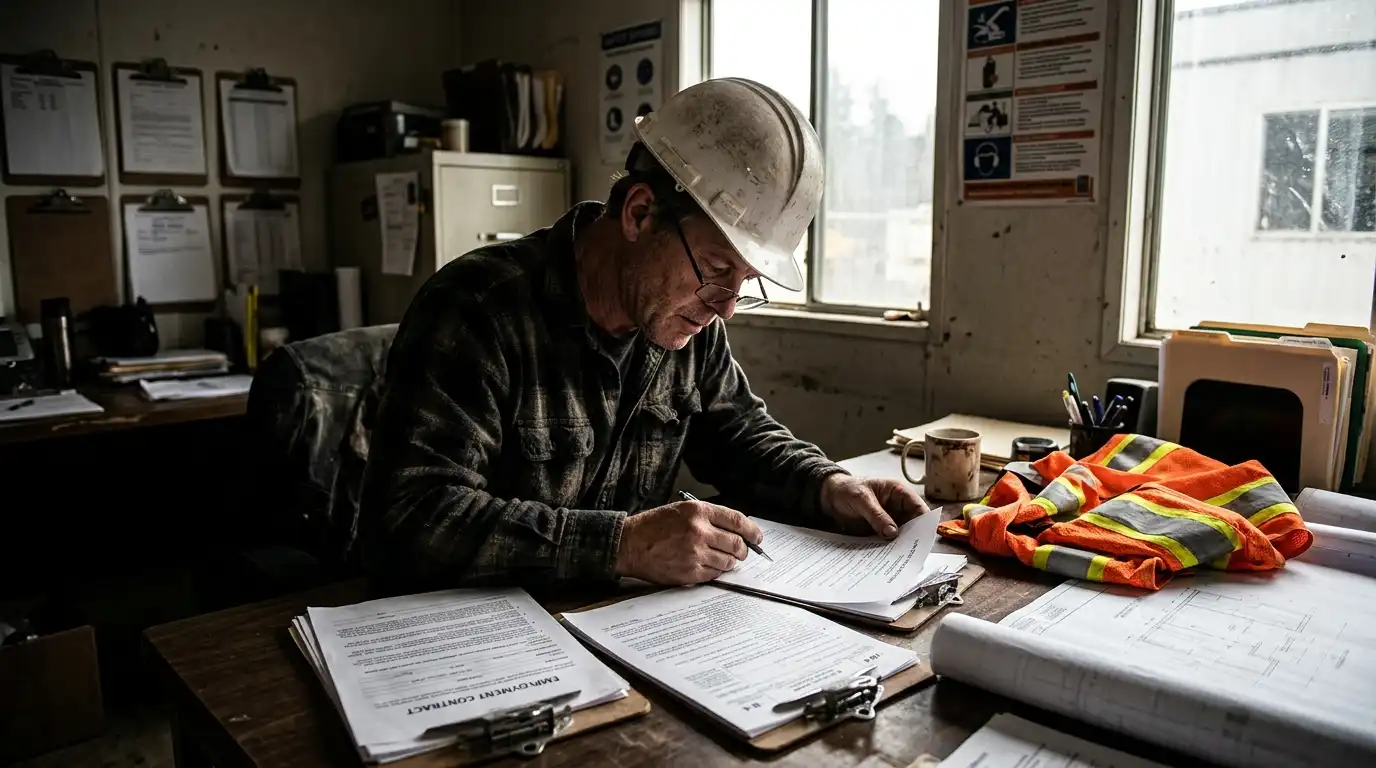
When an unexpected catastrophe strikes on a job site—such as a scaffold collapse, power tool malfunction, or trench cave-in—your legal employment status dictates how you will pay for emergency medical care and replace lost wages. Understanding whether you were legally misclassified by an employer can mean the difference between recovering total financial compensation or having your injury claim flatly denied by insurance carriers.
Why Construction Companies Misclassify Their Workers

Under state and federal employment laws, traditional W-2 employers are obligated to provide a robust safety net for their staff. This includes contributing to state unemployment funds, paying social security taxes, guaranteeing minimum wage standards, and maintaining statutory workers’ compensation insurance. By labeling a trade laborer as an independent contractor, unscrupulous construction companies drastically reduce payroll overhead—often cutting operating expenses by 20% to 30%—and shift financial liability entirely onto individual workers.
Common systemic tactics used to misclassify construction workers include:
- Forced 1099 Signing: Requiring laborers to sign IRS Form 1099 or independent contractor agreements as an absolute prerequisite for job placement, despite managing them like regular employees.
- Off-the-Books Cash Payments: Paying trade workers in cash or personal checks without formal tax withholdings or official payroll stubs to conceal the employment relationship.
- The “Hand Tool” Pretext: Falsely claiming that because a carpenter, painter, or electrician brings their personal hand tools to the job site, they automatically operate an independent business entity.
- Shell Subcontractor Networks: Setting up middleman “subcontracting companies” to shield the primary general contractor from direct employment liabilities and safety compliance oversight.
How Employment Status Shapes Your Post-Accident Injury Rights
Following a severe construction site injury, your classification status instantly dictates the legal avenues available for financial recovery. The distinction between an employee and a contractor creates vastly different legal pathways:
1. Statutory Workers’ Compensation Coverage
In almost every state, legitimate W-2 employees are automatically protected under mandatory workers’ compensation laws. Workers’ comp functions as a no-fault insurance program that covers all necessary medical treatment, emergency room visits, rehabilitation therapy, and partial lost wage benefits, regardless of who caused the workplace accident. True independent contractors, however, are routinely excluded from traditional workers’ compensation policies unless they purchase costly private insurance policies themselves.
2. Third-Party Personal Injury Lawsuits
While traditional employees are generally barred from filing personal injury lawsuits directly against their employer due to the “workers’ compensation exclusivity rule,” independent contractors are not bound by these same restrictions. If you are legitimately classified as a contractor and sustain an injury due to the negligence of a general contractor, property owner, or equipment manufacturer, you retain the legal right to file a third-party personal injury lawsuit. Personal injury claims allow injured victims to seek full compensation for pain, suffering, emotional distress, and 100% of uncollected lost wages—damages not covered under standard workers’ comp.
The Legal Tests Used to Determine Your Real Employment Status

An employer cannot strip away your statutory workplace protections simply by handing you a 1099 form or forcing you to sign a contract labeling you an “independent contractor.” Courts, administrative labor boards, and government regulatory agencies look beyond written job titles to evaluate the economic reality of your daily working relationship.
Federal agencies, such as the U.S. Department of Labor Wage and Hour Division, apply multi-factor legal tests to determine true employment classification. Key factors evaluated by administrative judges include:
- Degree of Direct Control: Does the general contractor set your daily work schedule, mandate specific safety protocols, provide heavy equipment, dictate sequence of tasks, and closely supervise your work? Direct managerial oversight strongly indicates an employer-employee relationship.
- Opportunity for Profit or Loss: Do you earn a fixed hourly rate set by the contractor, or do you negotiate custom contracts, manage project overhead, and bear the risk of financial loss on materials?
- Capital Investment in Equipment: Have you made substantial investments in commercial vehicles, specialized heavy machinery, and liability insurance, or are you relying entirely on the contractor’s site assets?
- Permanency and Duration: Have you worked continuously for a single general contractor on an ongoing basis for months or years, or do you actively advertise services to the open public?
- Integral Nature of the Work: Is the work you perform—such as framing, masonry, or roofing—a core component of the general contractor’s primary daily business operations?
Critical Steps to Take If You Were Injured and Misclassified
If you have suffered an injury on a construction job site while classified as an independent contractor, do not assume you are left without options. Worker misclassification is illegal, and workers’ compensation boards frequently reclassify injured workers retroactively, forcing non-compliant employers and their insurance carriers to extend full statutory benefits.
To protect your legal rights following a job site collision, fall, or equipment failure, take the following action steps immediately:
- Seek Immediate Medical Care: Visit an emergency room or urgent care facility right away, and inform treating doctors that your injury occurred on a commercial or residential construction site.
- Formally Report the Accident: Notify job site superintendents and site managers in writing, detailing the exact location, date, time, and circumstances surrounding the hazard.
- Preserve All Employment Records: Gather and store pay stubs, bank statements, text messages, daily work schedules, site sign-in logs, and photos of your work environment.
- Do Not Sign Liability Releases: Avoid signing post-accident waivers, settlement releases, or insurance forms provided by the general contractor before consulting a legal representative.
Navigating the complex intersection of employment law, state workers’ compensation boards, and personal injury litigation requires skilled legal representation. To learn more about securing full financial recovery following a catastrophic job site accident, explore the comprehensive resources available at Construction Injury Lawyer.